Showing posts with label Creamed Honey. Show all posts

Monday, 7 November 2016

Setting and Bottling


With the year's honey crop extracted and sat in buckets it wasn't quite time to kick back and relax. The honey bottling and half the crop needed turning into set honey too. The easiest way to make set honey is to add existing set honey to your liquid honey and mix it. I'd saved a few jars of last year's set honey for that very purpose.

Mixing set and liquid honey


After warming the set honey a little I added four jars to a bucket of liquid honey and stirred it with a honey creamer -a huge corkscrew type thing that you attach to a drill. It takes a while for the honey to mix properly. In the photo above the set honey's just been added and you can see it's very different in colour from the liquid honey that was already in the bucket. basically you keep stirring till it's all  the same colour. Once mixed it goes into jars and I gave it a week in the fridge to finish setting. Doesn't need to be in a fridge really just somewhere not warm. The first batch of set honey was then used to turn a few more buckets of liquid honey into set honey.

As last year I decided to do two sizes of honey jar, 454g jars which is the traditional 1lb honey jar and some smaller 250g jars. The 1lb jars came from Freeman & Harding just like every other year. The 250g jars I ordered via eBay from Compak South Ltd who were selling 96 jars for £26.48 which is a pretty good deal. Unfortunately when they arrived two jars were smashed in the box and two had faults in the glass rendering them unusable and Compak South didn't respond to emails. Eventually eBay offered a refund if I returned the jars but by then I'd used most of them so it wasn't feasible to. As a result I left them some negative feedback and a review on Trust Pilot. Looking at their feedback I can see I'm not the only person to have had a similar experience with them. Shame really as I've bought from them previously.

I'm no glazing expert but one of these doesn't look quite right to me.

Bottling honey is a simple process. Just pop a scales under the honey gate, sit a jar on it, zero the scales and pour out the honey till you hit the desired weight then close the gate and remove the jar. Inevitable this leads to a slight over filling of each jar but better to be over than under. Here's a quick video of some freshly mixed set honey going into a 250g jar, whilst I listen to The Rumjacks.

..and that's how it goes into the jar.

I've fitted honey gates to most of my small honey buckets but hadn't got round to fitting them on the larger buckets yet so I had to decant some from the buckets without gates into those that had. This led to some spillage as I'd actually left pen the gate on the bucket I was pouring it into. Ooops. Luckily I had my buckets standing in some great big plastic Garland Trays which meant clear up wasn't a problem, on the downside they're not food grade plastic so the spilt honey couldn't be used.
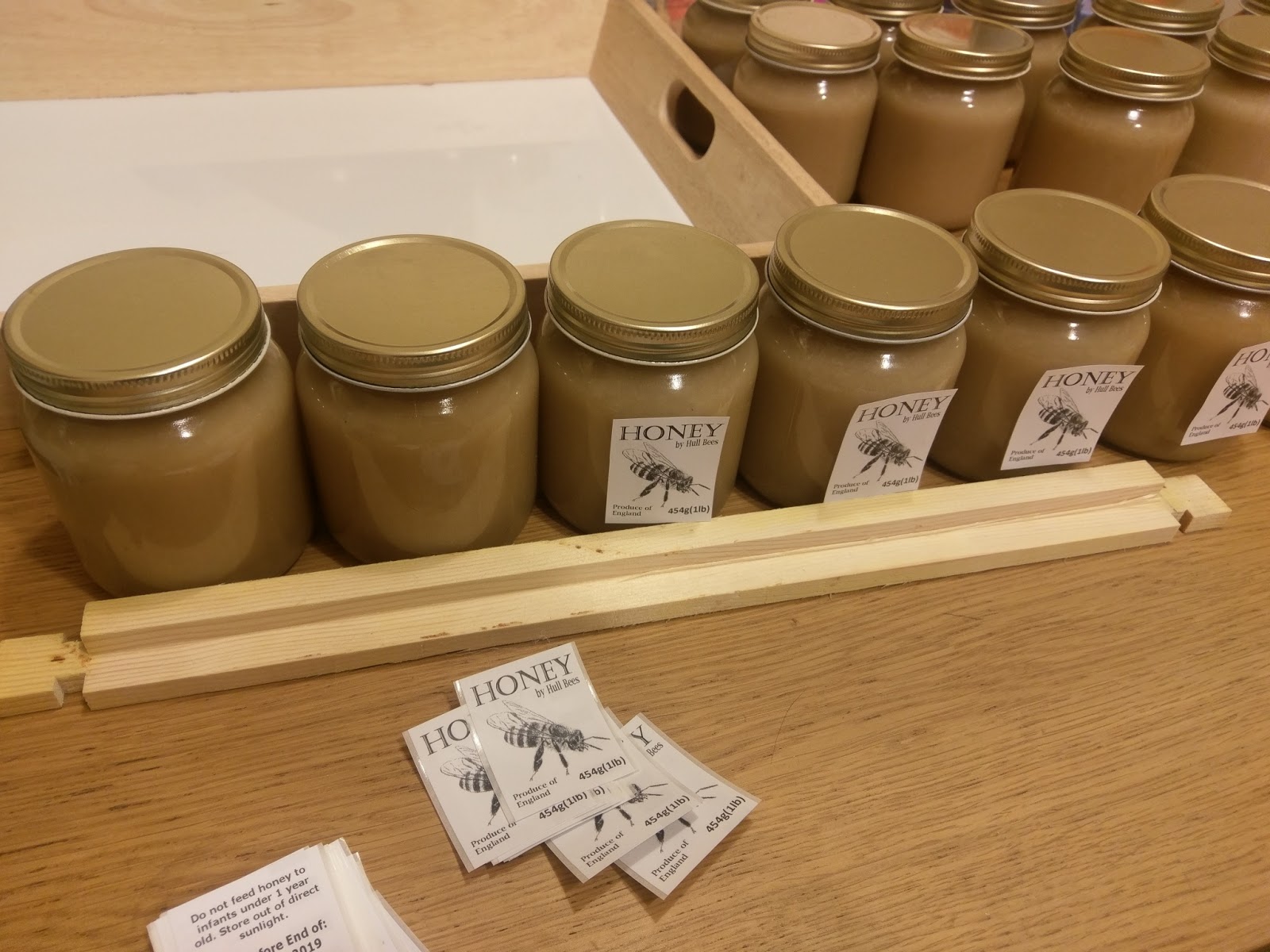

There were over 200 jars in total. Like last year I printed my own labels on a Brother QL-570 thermal label printer. I got it on sale a year or two ago and never looked back. Being a thermal printer there's no ink involved and it has a built in cutter so you can make labels any size from a continuous roll. I'd been thinking of making a jig to put jars in to line the labels up but in the end I just used a spare frame top bar to line them up doing a few at a time. I pulled out about 80KG of honey from the hives. After spillage and minus a few jars there's about 73KG left to sell on.

2016 Honey Crop

Wednesday, 13 January 2016

Soft Set Honey

Honey is normally a liquid but it's often sold as Set or Creamed Honey. This is the stuff that doesn't run, sticks to your knife and is easier to spread on your toast. It tastes the same as liquid honey, in fact it's actually the same stuff except it's physical state has been altered by encouraging it to crystallise in a controlled way. Left to it's own devices liquid honey crystallises and needs warming to melt it again. This process is called granulation. At some point in distant days of yore some bright spark who's name history seems to have forgotten discovered that if you seed liquid honey with honey that has already formed small crystals the liquid honey will form crystals the same size. I have no idea how that works, probably some complicated metallurgy stuff going on there, but work it certainly does.

As I wanted to label my honey as Produce of England I figured I'd best get some English seed honey to start the process. Turns out this is actually far easier said than done, late at night anyway, if it was daytime I could've probably just got some from another bee keeper.. anyway I tried 5 supermarkets before I was able to find any English Honey, everything on the shelves in Tesco and Sainsbury's was a blend of "EU and Non EU" Honey. It wasn't till I got to Asda that I found English Set Honey. Well done Asda for selling English Honey. But unfortunately also big black mark to Asda for sticking a Bumble Bee on the label instead of an actual Honey Bee. D'oh.

Actually in 2014 this stuff was withdrawn from sale after some came into contact with South African Honey by accident. Having been mixed with South African honey they couldn't sell it as English that year. Oops. Red faces all round but I'm sure after a little shouting and some awkward foot shuffling they'll've tightened things up after that though.

English Set Honey from Asda -There's a mistake in this photo..
The smoothness of the set honey depends on the size of the crystals it forms, the larger crystals give a grittier feel to it, smaller crystals a smoother texture. I bought a handful of different set honeys to compare and there was quite range in crystal sizes. This English Set Honey was really smooth, which is what I'd expect given the label suggests it's a premium product.

Asda's English Honey meets my English Honey

The first thing to do is add your seed honey to a bucket of liquid honey. Then stir. It's actually not easy stirring a bucket of honey for long, but not to worry technology to the rescue. A modern honey stirrer is like a 3' long blunt corkscrew made from food grade stainless steel that fits into a drill. You need to mix it evenly and avoid dragging air bubbles into the liquid.


The noise of the drill should give some indication of how much work is involved. It must've been really hard work prior to electronic shortcuts. Once mixed it looked a bit like a coffee.

Liquid and seed honey mixed
Once mixed it was decanted into jars and put somewhere cool to crystallise. I opted to use my Honey Warming Cabinet. It's an insulated box after all. Obviously I didn't turn it on and loaded it up in the evening when it was cool then closing the door seemed to do the trick.

Everybody be cool..
I gave it a few weeks to crystallise probably didn't need quite as long as I gave it. With the first batch done I was able to use these to seed more buckets of honey, and rather than go to the shed I left some in the fridge to cool. I'd turned the fridge up to it's warmest setting as if it's too cold it slows crystallisation.

Chilling. A bit.
 I didn't set the whole honey crop as some people prefer their honey in it's natural state. I put it in three sizes of jar, 250g, 365g and 454g. 454g is the traditional Pound of honey.

45 Kilos of Local Honey.
Some readers may be wondering how it was possible for Set Honey to be made in the first place if you already need a couple of jars full to make it. There is another way. You start with some heavily granulated honey and grind it with a mortar and pestle breaking up the large sugar crystals.

Granulated Honey in a Mortar

Same honey after some heavy grinding


It's harder work than you'd imagine and you have to do a very small batch at a time to get it even. I assume commercial outfits like whoever made the Asda English Set Honey will probably have some high tech machinery to do the job or possibly even some clever sciencey temperature controlled set up but if you have the time you can do it yourself. Once you've creamed a two or three jars you can use them to seed a bucket and when that sets use it to seed more buckets. If you store it right you should be able to use some of that next year to seed your next crop.

The original granulated honey and the ground honey

Ready for mixing with liquid honey
This is actually the first way I tried to make set honey, using a heavily granulated jar I'd saved from a couple of years ago. Unfortunately I made a beginner's mistake and tried to do it in July. It was too warm and the bucket didn't crystallise as hoped. In hindsight I would've probably been okay if I'd put the bucket in the fridge.. But not to worry, if your attempt to make a set honey goes wrong all you need to do is warm it up to return it to it's liquid state and you're ready to go again.