Showing posts with label Frogs. Show all posts

Monday, 17 April 2017

Start of the 2017 Season

Whether you're following Meteorological or Astrological Seasons we're definitely into Spring now. Frogs have been spawning and the newts are getting a little frisky.

Frogs have been busy

Couple of Newts, my ponds are full of life.

The winter was very mild, Spring too. Unfortunately out of my eight colonies three didn't make it through Spring. My money is on Varroa as the mild Winter probably meant the bees were raising brood through most of Winter allowing the Varroa to continue reproducing when there's normally a break. The mild winter also delayed Oxalic Acid treatment till February, I'm pretty sure the bees will have had some brood when I did that too which will have reduced the effectiveness of the treatment - it only affects adult mites living on the bees, mites in the comb with developing bees are affected. I started the season treating the remaining hives with Apiguard but mite drop was so low I discontinued it after giving the first treatment two weeks.

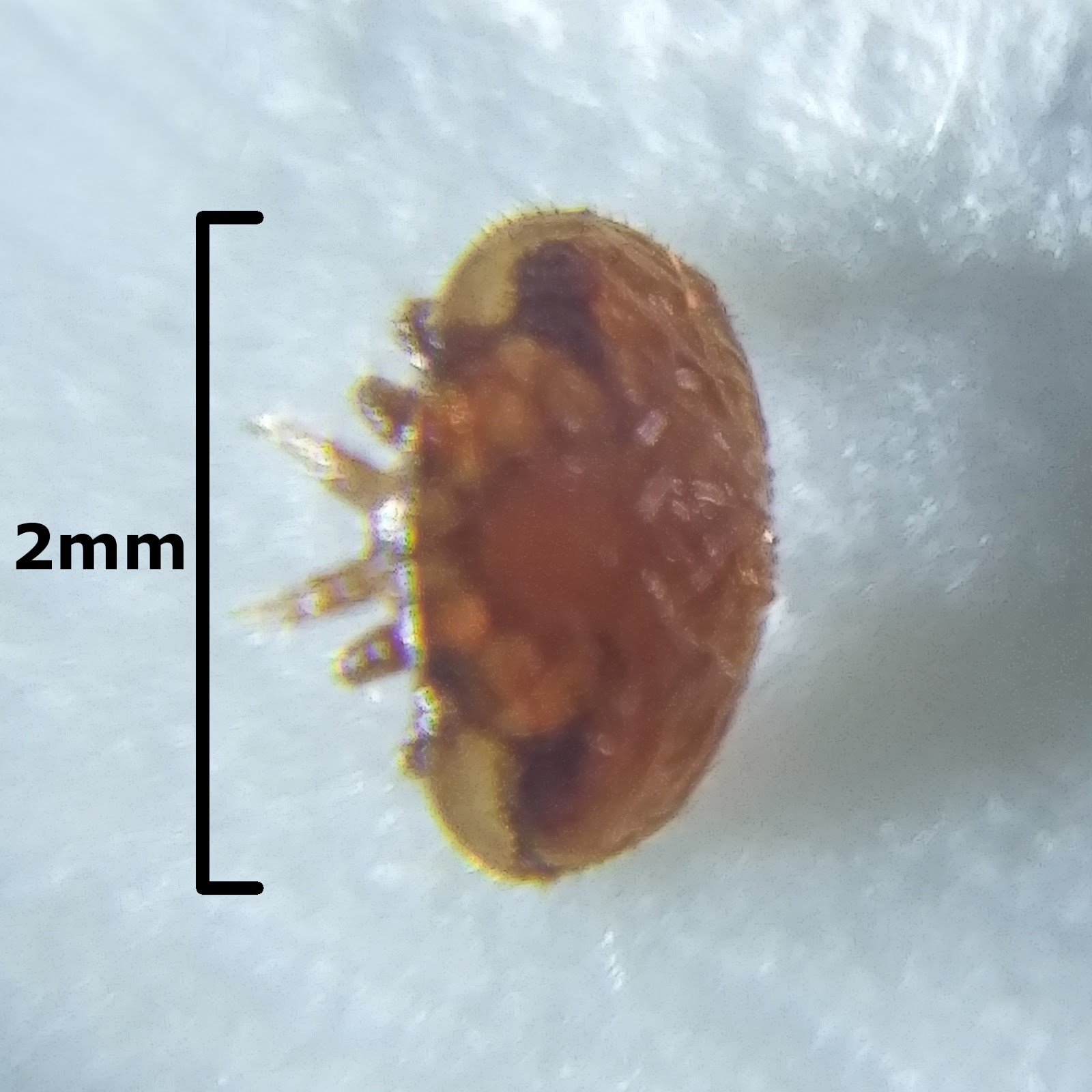
Adult Female Varroa Destructor.
She's been in an alcohol bath in my fridge for a few years.
I did my first proper hive inspections on 3rd of April. At the Apiary the hives were surprisingly prolific for the time of year. Straight away I had to carry out an artificial swarm for one colony who as well being heavy on bee numbers had already made a swarm cell with a developing larvae in it. My plan is mainly to perform vertical artificial swarms and later reunite colonies but as I've lost a few colonies I'm initially going to be increasing numbers so I did a regular artificial swarm moving the Queen Cell, brood and young bees to another hive and leaving the old queen and foragers in the original hive. A week later I checked the artificial swarm again to remove the emergency Queen cells the workers threw up following the manipulation. The original swarm cell was capped at this point and should be emerging about now.

Capped Queen Cell

I also remarked a couple of Queens who's marks had worn away making them harder to spot. Those Posca Paint Pens are easier to use than paint and a brush but doesn't seem as durable. Last year the official colour for Queen marking was white, it doesn't stand out too well against comb and brood though so I used a  metallic pink instead. This year's colour is yellow which will stand out even less against wax, bees and pollen so I've decided to go my own way again and use a bright orange paint pen.

One of last years Queens being remarked.
I'm now a couple of inspections into the season and I've got supers on all the hives, one has two on now and I've done another artificial swarm too. Whilst the Spring losses were the worst I've had so far the surviving colonies appear to be thriving at the moment and one is making some real headway on filling the supers too.


Wednesday, 10 August 2016

Yellow Bees, Smoker Spiders and Others

On a recent hive inspection I was surprised to see a round yellow dot moving about on a frame of bees. Normally a round yellow dot is a Queen Bee marking to show she was born in a year ending in a 2 or a 7. Blowing on the comb to separate the bees a bit it tuned out to be a worker.

Yellow marked worker?

I initially wondered if someone was doing some sort of test to see where bees were coming from and going to but if that was the case I should've seen more marked bees. I reached out and touched the bee and as the bee moved from under my thinly gloved finger the mark rubbed off. It was pollen. I found another one looking the same in another hive too.

And another yellow dot
Wasps have started making an appearance round the hives and I've even spotted a couple fighting with bees. Not seen many yet but depending how their numbers are this Summer I may put out a trap. I filmed one butchering a dead bee . I've filmed this before but this is a clearer video -better camera phone, less obstacles, better lighting, friendlier wasp and so on.

Wasp butchering a dead bee

As well as prodding pollen covered bees and annoying wasps with my phone I've made yet another brood box, finishing off the floorboards I was given last year -made three brood boxes, two nucs and a roof with them which I think is pretty good going.

Another Commercial Brood Box ready for painting.
I've also been observing urban wildlife in the garden and apiary and taking a few photographs. Recently upgraded my phone to an HTC 10, the camera is excellent -getting the bees to stand still is a little tricky though.


Spider on my Smoker. D-8

Buff Tailed Bumble Bee (Bombus terrestris) I think


A male Red-tailed bumblebee (Bombus lapidarius)

Honey Bee collecting Nectar and covered in Pollen

Drone Fly (Eristalis tenax), a sort of over muscled hover fly

Common Frog (Rana temporaria)
One of the cats keeps releasing these into the house.


Wednesday, 23 March 2016

Spring Time and Winter Losses

Quick entry as we're into spring. On the 20th March Google told us it was Vernal Equinox. That's the first day of Spring. Sort of. If you use the Astronomical Calendar 20th of March is the first day of Spring, but if you use the Meteorological Calendar it started on 1st March. The Astronomical Calendar is based upon the angle of the Earth relative to it's orbit of the sun whereas the Meteorological Calendar is based upon the weather -yep there's clues in the names I know. Today whichever calendar you prefer to use we're definitely in Spring.

Toby sat on a hive

Going into Winter I had 6 colonies, unfortunately one didn't make it through. Well actually they did make it through to early March but seem to have died off during March despite having plenty of food. It's been a strange month with the weather being a car crash mish mash of tshirt weather one day and freezing the next. Last week I'd listened to the hives with a stethoscope and noticed no noise from one hive. After waiting for a warm day I had a look inside and was disappointed to find no bees responding to the intrusion. I had a quick look through the frames and found that although there was still plenty of food stores in the hive the bees had perished clustered away from it. I think this had been my smallest colony going into winter and the cold snap in March seems to have thrown them. They'ed even started rearing brood at some point. This is the second colony I've lost to Winter in 5 years. For a beginner beekeeper that's pretty good but it's still quite annoying. It's still too cold to be inspecting colonies but after hefting the hives (lifting the side to check the weight) I decided to give two of them some fondant to gnaw on.

Other bees have been flying too. Yesterday I spotted a large Bumble Bee foraging the flowers. I don't know what type of Bumble Bee she was but given the timing and her size she had to be a Queen -it's too early for Workers and Drones.

Queen Bumble out foraging
Frog activity is usually a good sign things are warming up too. Last week I took a female frog off Toby the Cat and noticed she seemed rather plump, I figured she was probably heavy with eggs and this week the presence of frogspawn in the ponds at home and my out apiary was clear evidence the amorous amphibians had deemed it warm enough to do rude things in public. They don't always get it right though and they've spawned before freezing spells in the past, fingers crossed they got it right this time.

Frogspawn is appearing
Some March days my bees have been flying and I'd already spotted some bringing in pollen which suggests they were raising brood. They've also been seen gathering water from a couple of locations. Today there was a few heading to a neighbours waterlogged trough (a galvanised planter with no drainage hole) and apparently sucking up water from the mud. Probably far safer than using the currently frog infested ponds.

Gathering water from a trough of mud.
This makes me think that perhaps instead of making a regular pond or water feature maybe an artificial boggy area may be a better as a water source for them. Just a hole in the ground, lined with pond liner, backfilled with lose soil and waterlogged. It's an idea I'll possibly revisit later in the year. Speaking of mud..

Ground Beetle Larva
-some sort of Carabidae
I met a Ground Beetle Larva the other day. It's not really bee related but I liked the photo. These things are pretty useful for gardeners as they eat slugs so if you find one best to leave it alone to protect your plants, potatoes or whatever. Not all larvae are predators but you don't need a degree in entomology to figure out which ones are useful, those large jaws are a dead giveaway that this is a predator.

Sunday, 2 June 2013

Water Gathering and Frog Life

Another inspection done and I'm pretty sure Hive1 is queenless. I'd marked with red paint last month but haven't seen her since. I also couldn't see any eggs in the hive this time. It's quite possible that after marking her the workers took a dislike to her and offed her, bit odd they didn't start making a replacement though. There's also always the chance she's still in there but really good at hiding and not currently laying any eggs but I doubt that and if she's not laying eggs she needs replacing anyway. When I inspected them on Friday I moved a frame with eggs from Hive2 over to Hive1 so if they need a queen they can get on with making a new one. When I inspect them next week I should know for certain as there'll be queen cells on the fame I added. If they've not made any Queen cells then the Queens in there and I need to revisit the drawing board -or more likely find, squish and replace her.

Today it's been warm and sunny and the bees have been busy gathering water. In their first year they only collected from the bird bath but this years they're collecting from the nearest pond as well.

"We'll be fine if we act like a sparrows."

Sunny day

Air traffic over the pond was a bit honeybee heavy but I spotted a black and yellow thing flying about that was different. It was a Sunfly or Helophilus pendulus, a hover fly which wikipedia tells me is associated with waterbodies, such as my pond. They need very wet soil for their larvae which eat rotting matter and the adults pollinate plants for us. Helpful things to have round the garden, which is just as well as they're apparently very common.

Sunfly sunbathing poolside

Collecting water is a hazardous job for bees. There's always the chance they'll fall in. Failing that there's a load of frogs who'd like a bee or two to dine on. There's a large contingent of tadpoles in both ponds at the moment and adult frogs can be seen and heard in the garden too.

Common Frog Tadpoles

Come on in the water's fine.


"Hello bee, what's it like having legs? I'm thinking of growing some myself."
"Well I like em. I've got six and they have these dead useful grippy things on the end."
"I'm thinking of four, two big ones and the back and a couple of small ones at the front."

Stand off.

Thursday, 12 July 2012

More Visitors to the Hive

Recently I've been seeing a few more creatures around the hive. Honey Bees being a part of our ecology naturally interact with other flora an fauna. Whilst they get pollen and nectar from various plants they also tend to get eaten by a lot of things and drop various edible bits along the way.

Common Carder Bee

Previously I found some Common Carder Bees had set up colonies in the ground below the nuc. Unfortunately not long after posting about them and how I was hoping to watch them over the summer it rained and they seem to have died off :(


This evening I found this large black bumble bee investigating the ground below the hives. Annoyingly it refused to keep still to oblige me with a photograph so 3 seconds of video will have to suffice. There's quite a few species of bumble bee and I've no idea which this one was. It seemed to be examining the ground below the hives and had a bit of a buzz against the mesh floors but didn't enter the hives -I doubt the guards would have let it in if it'd tried anyway. I suspect the Common Carders and this Bumble Bee were attracted by the scent of the hive with it's wax comb, developing brood and the queen's pheromones wafting about.

"I wasn't eating your bees, honest guv."
A few years ago I made a pond and once it was stable I introduced some Common Frog tadpoles with a view to them controlling slugs which were over running the garden. It seems to have worked and having added a second pond and more spawn and tadpoles from other sources to deepen the gene pool the frogs are still here 6 years later.

On his(?) way to chomp on some eusocial insects.

Recently I noticed a couple of them sitting about below the nucleus, I haven't seen one catching bees yet but they certainly do eat them. It's be quite handy if they ate the dead bees below the hives but unfortunately they only eat moving things, offer them as many dead bees as you like and they'll sit waitng for a live one to fly over. I gather toads will eat dead bees from the ground though so perhaps I should look into acquiring some of those. Note: Anyone wanting to do something similar should bear in mind that in the UK it's actually illegal to remove frogspawn (and no doubt toad eggs) from natural habititats so if you want to introduce some to your own pond and there's no chance of them getting there naturally you need to find an obliging pond owner who'll help you out.

Red Eyed Damsel Fly on a Water Soldier,
also a discarded nymph skin to the right.
Other pond life that eats bees are the Damsel Flies. Here's a photo of a recently emerged one I took last summer. I'm fairly certain this one's a male Red Eyed Damsel Fly, mainly on the strength of it's size although the red eyes are a bit of a giveaway too. I've not seen any dragon flies round my own ponds but if there are any they'll be happy to nosh on a honey bee too.

It's not just the ponds that provide plenty of predators for my poor bees. I've mentioned in a previous post that I'm sure it's not just a coincidence that the birdbox which remained empty for years became occupied by Blue Tits in my second season of beekeeping.

I've recently been finding spider threads near the hives where an industrious spider with an eye for opportunity must've thought it was going to hit paydirt. Well it might've if I didn't keep brushing them away. On  my last inspection I found a spider in the roof.

"Thought I'd have a bee for tea."

No idea what kind of spider it is, but it's legspan was about 2 inches and it lacks the white cross shape on it's back that would identify it as a Garden Spider.

This little guy was about 4mm big.

Recently I found a couple of small insects with long antenna wandering about on the bottom board. There's plenty to eat on there such as dropped nectar, pollen, sugar sypup, wax, bits of bees, dropped varroa and general detritus. I also sometimes see some really small pinkish spider mites running about on the board. In nature bee colonies are meant to live in cavities in trees and no doubt they'ed share their home with other things like woodlice too.

There's also of course the varroa who attach themselves to bees and suck out haemolymph, as well as these there's a few other mite types that live on or in the bees too, a common one being Tropilaelaps although I've not yet noticed any myself.. I'm currently treating the nucleus for Varroa using Apilife Var -a natural product that kills varroa, dissolves plastic and gets bees pretty angry, so it's not unusual for me to find dead varroa under there at the moment. It's recently been discovered -or more likely rediscovered  or remembered that pseudoscorpions predate the varroa mite and there are currently studies going on into whether or not they can be used as a biological control within hives.

Other creatures that interact with honey bees but so far haven't been a problem for me include mice (hence the need for winter mouseguards), badgers, woodpeckers, slugs and wax moth.

In the UK our bears were long ago hunted to extinction along with boars and wolves -I can't help wondering what the third world makes of that when we're lecturing to them about their elephants and rhinos... So whilst bears would rob hives, it's very unlikely your bees will ever even see one unless your apiary is next to a zoo. There is a popular belief that bees have an inherent dislike of bear shaped things which some argue effect the choice of colour a beekeeper ought to wear whilst working their hives. For example it's often suggested that dark or black clothing and in particular gloves may trigger an angry response from a colony mistaking  the dark beekeeper for bear, albeit a very skinny (hungry?) one. For that reason a lot of beekeepers wear lighter coloured or white protective kit. Any goths out there attracted to the idea of a hobby that involves being surrounded by smoke might want to bear that in mind, although I suspect the sunlight and heavy lifting may put them off anyway. Of course some people think that's nonsense and choose their wardrobe with impunity. I tend to wear black jeans and a green smock when working my hives. Having used both black and yellow rubber gloves and had bees sting through both my own theory is that bees simply don't like people riffling through their hives and don't really care what colour you're wearing for the occassion.