Showing posts with label Pearson Park Wildlife Garden. Show all posts

Tuesday, 16 September 2014

September insect activity

By now most beekeepers will probably have removed their Supers and be dusting off the honey extractors for this years crop by now but the weather seems to move a little slower over here in Hull. At present the hives are ..well.. hives of activity. One lunchtime last week filmed a few minutes of the activity  outside the hives, holding my phone near the entrance of Hive3

Activity at the Hive entrance on 5th September 2014

Looking back at my records I can see I took in the 2011 crop on 1st September and the the 2012 crop in late September. This year I'll be removing the Supers in late September again. It's not a particularly good crop to be honest. Hive3 with the two united swarms gathered plenty of honey in their brood box but refused to put any of it up into the super. I tried bruising the cappings of the ripe honey to encourage them and they did move the stuff but instead of moving it upwards they moved it sideways so it's actually still in the brood box. Contrary creatures. Hive1 and Hive2 have been using the supers but neither are looking particularly full either and I don't think that's likely to change before I remove them. I've really only left the super on Hive2 as it's housing so many workers at the moment.

I took my phone down to Pearson Park and the Wildlife Garden on Monday , the bees there were still busy too and like mine still have a super on their hive. As I had my phone in my pocket I took a few photos of pollinating insects at work in the park.

Honeybee on a yellow rose


Drone Fly (Eristalis tenax)

Honey Bee working flowers on a tall marginal plant
Bumble Bee in a flower

Different Dronefly (Eristalis sp.) on a Coreposis gigantea
In my garden I spotted a couple of Harlequin Ladybird Larvae, these things look like monsters from a bad sci-fi film. But what's unusual is according the UK Ladybird Survey they should've been at this stage in July and developed into Pupae in early August and into adult Ladybirds  by now.

Harlequin Ladybird Larvae.
Still on the predator front I noticed a lot of spiders on my plants at the moment too. One keeps making a web by the hives and catches the odd bee. I tend to brush that aside on a daily basis. I think they're mainly European Garden Spiders.

European Garden Spider
Actually a couple of weeks ago when Hive3 was being particularly boisterous, I'd walked to the other end of the garden and was brushing off angry bees off me I saw a spider looking like a disgusting dark grey gobstopper attached to my arm. Regular readers may have picked up that I'm not massively keep on the eight legged garden dwellers. I may have shouted a rather short word the neighbours probably didn't want their kids hearing as I batted it off. I suspect that it's round shape meant it was carrying eggs.

I also saw the very first wasp of the season buzzing round the hives. It didn't stay still long enough for a photograph though. I'll be expecting a few more to be appearing soon.

Last week on Newland Avenue I also spotted some sort of large wood boring wasp. It was over an inch long and looks pretty horrific -looked worse in flight- but that long pointy bit at the back looking a little like a needle is actually for making holes in wood where she'll lay her eggs and these things don't actually have a sting at all.

Wood Boring Wasp of some kind


Tuesday, 9 September 2014

Down In The Park (almost)

We didn't have time to look at the apiary in Pearson Park Wildlife Garden during the Avenues Open Gardens this year but I popped down to have a quick look last weekend. When I first blogged about the garden in August 2011 they had two hives, a  WBC and a Kenyan Top Bar Hive. Later in 2012 a National hive was added bringing them up to three colonies.


November 2013
In November 2013 I noticed the topbar hive was gone. I know it was there in September 2012 but don't know if it survived the 2012/2013 winter or was united into one of the other hives. It's certainly easier to manage your bees if they're all on the same frame type.

August 2014 Single Brood Box
When I went to look on 17th August 2014 there was just the one lonely looking hive consisting of a brood box and a super. I thought maybe the two colonies had been united but a little digging on the web turned up a story of the bees arrival and mentioned that unfortunately their previous colony hadn't made it through the winter, doesn't mention the other colony but perhaps they were united. So this is actually a new colony that arrived in July.


You can see the frame of the Queen Excluder
between the Brood Box and the Super.

Today when I went to have a look it seems the bees' fortunes have changed and they were on a brood and a half. So as well as a regular deep box for the brood there was another super below the Queen Excluder which was also being used for brood rearing. Using a brood and a half is fairly common these days in the UK as the National  sized brood boxes we seem to have standardised with are one of the smaller hive types. Whilst it does mean you have two boxes and twice as many frames to manage and search for the Queen in, it increases the number of cells available in the brood box from 54,000 to 81,000 (the Commercial brood boxes I use have room for about 80,000 cells for comparison). You can tell it's a brood and a half and not two supers by the position of the Queen Excluder.

Brood and a Half
September is a little late to have a super still in place but this year we're having a strangely warm month and I've still got them in place on my hives at the moment too. Whilst I was loitering with phone in hand I decided to zoom in and film a little of the activity at the hive entrance. If you never seen black dots moving about on a screen before you're in for a treat :)


In October last year a new shed appeared on the site which I felt photoworthy. It was an art installation from the 2013 Freedom Festival and here's a snap of it for your delectation:


The Shed.

Tuesday, 4 September 2012

Pearson Park Wildlife Garden

I've mentioned the Pearson Park Wildlife Garden previously in this blog. It continues to be a work in progress and still has very little by way of web presence -very little by way of any publicity at all really I suspect if I didn't pass the entrance on an occassional run I wouldn't've noticed it existed myself.

Welcome to the Just Outside the South Corner of Pearson Park, Wildlife Garden

The Yorkshire Wildlife Trust actually has two web pages for it here and here neither of which really inspire a visit unfortunately. There's also a Facebook Page which has various green links pictures and requests for volunteers, created in September 2011 it has 136 likes at the time of writing so evidently it's not really being pushed at the moment. Oh there's also some pretty good pictures of the denizens of the garden (and the park) on the Wild at Hull blog.

Free herbs for all!
One reason to visit the garden is to pick up some free herbs. They have an impressive herb garden you can pop to and snip a little of whatever you need from. I didn't see much by way of signage though so you'll have to be able to recognise what you want.

There's things wriggling in that water
The project also has a pond which is quite large, albeit very shallow. I'm not entirely sure what uses the pond but I think I've seen dragonflies in the area and there's definitely damselflies. I'd assume there's a frog population too and I've been told there's newts in the main pond in the park so I'd expect there to be a few in here too.

A pile of wood. Things sleep in it. Not just rats. Hopefully.

There's various piles of stuff for wildlife to sleep/nest or hibernate in ranging from woodpiles to pallets of various bits of stuff like twigs, bamboo canes, paper, sand and other stuff which whilst about as pleasing to the eye as a quick poke with a pencil should be useful for the wildlife. There's also some bundles of tied twigs and sticks which probably have some practical purpose other than giving the place a slightly sinister Blair Witch feel. There's also seating areas, bird baths, bird tables, bird boxes, bat boxes and a vegetable plot tucked out of the way. A little fenced off area with a tended lawn houses a rain guage and a Stevenson Screen which I would assume houses some temperature and humidity measuring kit. I think the place would be better off losing that really and having a bit more nature space but it's probably got some educational purpose or something.

By now you're probably thinking "This is another WTF about the bees posts.." well I was getting to that. Slowly. I've previously mentioned that the wildlife garden acquired a colony of Carniolans in a WBC hive in 2010. Whilst these originally slavik bees are particularly good at overwintering they perished in the freakishly long and snowy 2010/2011 winter. As a breed they actually have quite a reputation for swarming so they're possibly not the best choice for a city apiary. However they soon got some more bees, I don't know what type but when I encoutered a girl there emptying dead bees from the WBC she'd said they were hoping to catch a local swarm so probably buckfasts or some mongrel derivative. This year they've made it through very easy winter and also rather difficult sprin.

WBC, National and Topbar Hives
For reasons unknown to me they seem keen to mix it up a little in their apiary.  After getting some more bees into their WBC hive (the one on the left with the slanty sides and sloping roof) they added a kenyan top bar hive (the dark brown tabley looking one on the right) and this year's new addition is a National Hive (middle one like a tin topped tea chest). The National is meant to be something of a standard hive in England at present. It uses frames interchangeable with the WBC and I'd guess it was added to house an artificial swarm from the WBC, although I could be wrong -haven't actually asked anyone afterall. The kenyan top bar hive (actuall invented in the UK and not Kenya, but popular there) seems to have been turned and the entrance moved. When I looked at it in the winter it had the entrance at one end facing forwards like the WBC but now the entrance is in the middle of the side.

Drone Fly, declined to look at the camera.
Ther herb garden seemed popular with various polinators such as the drone fly above, a range of bumble bees, the park's resident honey bees, hover flies and just to add a little confusion for any budding entymologists and photographers hoverflies pretending to be bees. Given the distance I've no doubt my own bees forage here too and there's a pretty good chance my Queens have mated with drones from these hives.

Some kind of Bumble Bee, bumbling. As they do.

Honey Bee, working hard in the herb garden.


A bee happily working a red flower, except she thinks it's black
because bees can't see red. So there.

Friday, 16 March 2012

Why My Hives Look Like an Oil Tank

Another post about hive insulation? 'fraid so.

Having already added a layer of space board insulation beow the hive roof in December I turned my attention to the sides of the hives. My hives are single walled as are most of the hives in the UK, single walled means there's one wall between the inside of the hive and the outside world.  The now less common but more aesthetically pleasing William Broughton Carr (WBC) hives have an extra walls around the boxes the bees live in. There's a couple of reasons why he designed his hives this way but having a stack of boxes within another stack of boxes looks like quite a faff to me. However modern houses in the UK have cavity walls for extra insulation so I decided to imitate that for my bees to give them a little extra insulation especially in the light of the previous winter's months of ice and snow.

The placement of the hives means that their front wall wich faces a wall and a corner is probably quite sheltered from winds but the back of the hive and the sides get the full effect. To reduce the effect of this I built a box to go around 3 sides of the hives and boxed up the gap between the hives at the front and on top. The edges where it meets the hives have draft excluder brushes on them to reduce the escape of warm air whilst the bottom is open and it goes down a little below the hive floor. My thinking is that it should provide some insulation from the elements on the more exposed sides of the hive whilst still letting the wooden hives breathe. I'm sure it doesn't make a massive difference but I'm expecting every little helps.The edges of the outer layer reaching below the hive floors should provide some protection for the open mesh floors from the winds too.

 
You too could have hives that look like an oil tank.
I painted the outside black to help it absorb heat -although it does look pretty ugly, and the inside a gloss white to (hopefully) stop it taking any heat from the hives. There is a downside to this as the extra layer of wood also slows the warming effect of the sun on the hives so on warmer days the bees will become active a little later, this is something known to happen with WBC hives, but my hope is that this will be outweighed by the benefit of less heat being lost when it's colder.

I left the green roofs in place but to be effective insulators there needs to be air in the gaps between the particles of the substrate (soil or perlite or whatever). In the summer that's not a problem and the sections insulate the roof against the sun but in the winter when they get waterlogged they stop insulating, not a problem with the spaceboard underneath already but next year I'll have to give some thought to drainage -which will be better for the plants too.

In February I popped down to the Pearson Park Wildlife Garden to see how their bees were doing and noticed they've used straw for upper insulation on their WBC hive. Those bees should be toasty warm because as mentoned above  as the WBC hive has double walls so there's an air gap between outer walls you can see in the and the walls around the bee cluster.

WBC Hive with straw insulation
The previous winter was a particularly long one and the wildlife garden actually lost their bees so I'd expect them not to be taking any chances this year. Although it looks like there's no extra insulation on their top bar hive at all.

Top Bar Hive in the snow
I'll be interested to see how these bees have coped, although having been a mild and short winter I'd expect them to be okay. General consensus is that as long as bees are dry enough and have enough food they should be able to cope with the cold. In case anyone's wondering that rock sitting on top of the hive roof is there to stop the flat roof being lifted by the wind, it's common practice with flat roofed hives.

Monday, 15 August 2011

Nearby Hives

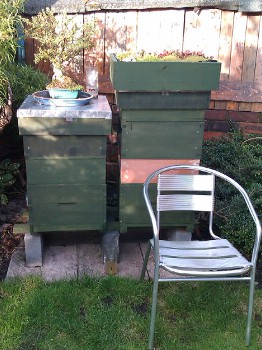
Over the summer whilst the bee populations have increased, the hives have also physically grown. One has a deep and a shallow super whilst the other has a shallow super. They've both got extra boxes on top as ekes.

My hives with a chair for scale

 There's a Wildlife Garden at Pearson Park with two hives. For reasons best known to themselves they've gone for two completely different hive types.

WBC Hive
This is the William Borough Carr hive (WBC) which is probably what most people think of when they picture a beehive.  From what I've read they sound like a complete pain to use compared to other hives -but they do look nicer and having double walls is good for insulation. However they are slightly smaller than Nationals. Some people like them, some people don't, but beekeepers don't seem to agree on anything so that's not too surprising. I think these hives are behind wire mesh to stop visitors getting themselves stung by annoying the bees.

Top Bar Hive
The Top Bar Hive (TBH) is really popular in developing countries, particularly Africa. You can make them yourself fairly easily using whatever's available and rather than using a complete framed piece of foundation for the bees to make comb on all you give them is a wooden bar with a line wax to get their attention, the bees can then draw their own comb. It's often touted as a more natural way of beekeeping than the modular hives with wooden frames and unlike the WBC, National and Commercial types it doesn't need boxes adding and removing so it's probaby easier on your back and means you don't need a couple of warehouses to store your empty supers in. I don't have a clue how you go about managing one of these but I'd assume it's very different to the modular hives. Being horizontal it has a larger footprint than the modular hives.