Tuesday, 16 August 2011

Musical Interlude

Joe Strummer & The Mescaleros: Johnny Appleseed

"If you're after getting the honey - hey
Then you don't go killing all the bees"

Monday, 15 August 2011

Nearby Hives

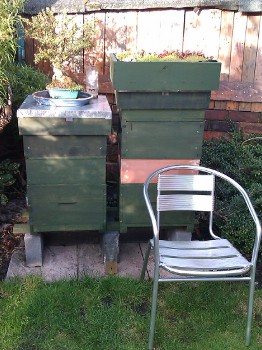
Over the summer whilst the bee populations have increased, the hives have also physically grown. One has a deep and a shallow super whilst the other has a shallow super. They've both got extra boxes on top as ekes.

My hives with a chair for scale

 There's a Wildlife Garden at Pearson Park with two hives. For reasons best known to themselves they've gone for two completely different hive types.

WBC Hive
This is the William Borough Carr hive (WBC) which is probably what most people think of when they picture a beehive.  From what I've read they sound like a complete pain to use compared to other hives -but they do look nicer and having double walls is good for insulation. However they are slightly smaller than Nationals. Some people like them, some people don't, but beekeepers don't seem to agree on anything so that's not too surprising. I think these hives are behind wire mesh to stop visitors getting themselves stung by annoying the bees.

Top Bar Hive
The Top Bar Hive (TBH) is really popular in developing countries, particularly Africa. You can make them yourself fairly easily using whatever's available and rather than using a complete framed piece of foundation for the bees to make comb on all you give them is a wooden bar with a line wax to get their attention, the bees can then draw their own comb. It's often touted as a more natural way of beekeeping than the modular hives with wooden frames and unlike the WBC, National and Commercial types it doesn't need boxes adding and removing so it's probaby easier on your back and means you don't need a couple of warehouses to store your empty supers in. I don't have a clue how you go about managing one of these but I'd assume it's very different to the modular hives. Being horizontal it has a larger footprint than the modular hives.

Sunday, 14 August 2011

Found the Queen of Hive2

Another week another hive inspection. All seems to be going well in both. Lots of eggs and brood and they're still bringing in nectar and pollen. In the shallow supers comb is being drawn but they've started to store in them already. The National Deep I added as a super whilst I phased out the National deep frames in Hive1 seems to be full now so it'll be time to extract soon -built myself a honey extractor, I'll say a bit more about that in a later post when it's time to use it. This week I spotted the queen in Hive2, she's a fat little thing and quite camera shy so it's a bit blurred.

Queen on frame of honey
I've finished sterilising the crownboards from the auction, also treated the outside edges with Shed & Fence paint. One of them needed escape holes cuting into it and another needed one adding and one widening so I got to have a play with the power saw. I've also sterilised the supers and begun painting them green too -taking a few coats to cover the brick red they're already painted and really it's just an aesthetic thing anyway. Two had plastic runners and one had metal ones, I've removed them and will be replacing them when I need to use them -although I plan to use two as ekes for feeders so shan't be needing to do that for a while.To sterilise the nails that I pulled out with the runners I dropped them on a piece of wood and got the blowtorch to them till they were red hot, I'm fairly confident that'll do the trick. Haven't made a start on the frames yet so got them tied up in bin bags at the moment. I'll probably deal with them in the winter when they're less likely to draw attention from the bees. The frame scraper and caping fork I acquired were treated to and hour of being boiled in a soda crystal solution whilst I watched an episode of Dexter and drank a Latte (hard work this bee keeping malarky) and came out gleaming -I'm going to varnish the scraper's wooden handle at some point to make it easier to keep clean. Meanwhile for your delectation here's 30 seconds of bees flying in and out of the hives:

Exciting isnt it? :p The nearest is Hive1 which has a huge population, Hive2 is less populous but the entrance looks almost as busy.  It was an overcast day of drizzle so there was less bee activity than I see on sunnier days.

I've spotted a few undertaker bees carrying dead bees for disposal away from the hives. Watched one on Saturday leave the hive I was inspecting and fly around the garden in clockwise circles which got wider and wider till it left the garden. No idea what that was about but I'd guess it was looking for a site to drop it's dead sister. Last week I watched another undertaker despoit a dead bee in one of the wildlife ponds. There's probably something in there that'll eat it.

Monday, 8 August 2011

Another auction? Don't mind if I do.

This weekend I went to get rained on at yet another auction. I've noticed beekeepers seem to be quite keen on auctions. Apparently some chap had decided to cease his beekeeping and so was selling off all his stuff. And what a lot of stuff there was, from the usual bits of various hive type to an extractor and a burco boiler. Someone from the local beekeeping association was letting the auction take place in his rather smart garden and the auctioneer was same guy who'd done the first auction I'd been to, aided by a girl who against the odds managed to keep track of who'd won what at what price.

Brood boxes
I came away with 3 supers, 3 crownboards, a capping fork, a frame scraper, two single hive stands, two double hive stands and 5 honey buckets. I don't need all those hive stands really, but they were a job lot for the princely sum of £2 and I thought one might be useful to put things on when I'm working my hives. Think I'll be popping the 3 I don't need on eBay or possibly chopping them up for the chimenea or maybe even donating them to a mate as firewood for the winter -yes some people in Hull still use wood for that. Likewise I really don't need 5 honey buckets but I can always store away the unneeded ones till I do. When you look into beekeeping people will tell you about all the obvious things you're going to need, things like some actual bees and things like something for them to live in. What people don't bother to mention is that you'll also need a large aircraft hanger to store all the bee related gubbins you'll accrue, most of which is very bulky and being for seasonal use will languish in storage for most of the year.
 
Auction in the rain
Whilst we were told all the kit was sterilised prior to the auction it'd be a bit unwise to rely on that. For now I've got the supers and tools all taped up in bin bags with little bowls of acetic acid (Note to self: next time use gloves handling that stuff) in each to kill various bee disease related nasties, after a week or so of that I'll remove the wax and clean up the wood as I did the hives earlier this year, I won't be needing them till next summer so won't be hurrying with it. At some point I may put some thought into changing the colour to match the rest, but that's just a minor thing really the reddish brown paint looks to be pretty tough stuff and probably offers more protection than the green I'm using at the moment. The existing wax comb I'll remove, and eventually melt, filter and probably try to flog. I spent today scorching the crownboards, making porter bee escape holes in two of them and treating their outer edges with shed and fence paint. If you're looking to start out in bee keeping you can save quite a bit by getting used kit, as long as you're prepared to spend a few hours (or days) sterilising it all later on.

Super!

Hive1 was looking decidedly crowded so I ordered a another super. I needed it in a hurry so I used eBay -I've noticed eBay sellers tend to post things a lot faster than commercial bee keeping suppliers and I was able to find someone selling an unused super with frames and foundation.

Cedar Super
I haven't treated this box with green paint like the rest of the hive as it's new cedar so, in theory at least, shouldn't need it and won't take paint too well. Maybe when it's weathered a bit I'll give it a go for the sake of aesthetics. Oh in case you're wondering "WTF is a super?" it's just a box that goes above the brood and bees store more honey in for the beekeeper to rob. In August you're really supposed to be thinking about removing the supers and extracting the honey but it seems that things are running a little late this year.

I inspected both hives on the Friday this week. Lots of eggs and brood in both, Hive2 is still catching up but they're storing honey in the super as well now. At the moment I have an entrance reducer on Hive2 to make it easier to defend from wasps and more importantly the bees in Hive1 as they're a far bigger colony at the moment.

Monday, 1 August 2011

Recycling!

As I mentioned before bees are vegetarian and get their protein from pollen but will happily recycle protein from brood if there's something wrong with it or they decide they don't need it -such as drone brood late in the year. I've also noticed a few bits of bee shell picked clean in the hives where a bee got trapped when I closed up, so I suspect they sometimes recycle each other too. So yes, whilst honeybees are vegetarian, they will eat their babies and their dead.

Bees eating pulled drone larva
On the last hive inspection I pulled out some drone larva to check them for varroa. Didn't find any mites at all (yay!) and then dropped the now dying larva back into the hive for the bees. There was one still on the capping fork so before popping the roof on I dropped it onto the crownboard and within a few seconds the bees were on it and tucking in.

Something else I thought the bees might like to recycle is their old beeswax and propolis. Going by the forums opinion is split as to whether or not bees will reuse old wax -although within the brood frames they'll tear down existing worker comb to make drone comb when they need it. Originally I tried leaving the lumps of cut out wax onto the crownboard for them to reach, it seemed to work but did tend to get welded to the board so I decided on another approach. Now I take the cut out burr comb and any scrapings, pop it in a box and freeze it, then rattle it like hell to smash up the now brittle wax, propolis and honey into really tiny pieces. I pop these into a margarine tub with tha hole in the side and stick that on the crownboard where they can reach it.

Bees reusing old wax and propolis
As you can see this seems to be working. I didn't do a before and after picture but when I dropped the box in you couldn't see any of the white floor of the box at all. The big lump you can see will be going back into the freezer with this weeks scrapings for breaking up another day, but the really small flakes of wax and propolis are being used

Whilst both hives are the same breed of bee I've noticed both have very different characteristics, if one were to anthopomorphisize you could say they have their own personalities. For example the bees in Hive2 seem more placid than those in Hive1. During an inspection the bees in Hive1 tend to congregate on top of the frames whereas those in Hive2 don't so much. I've also noticed that the bees in Hive2 are very quick when it comes to drawing new comb from foundation in new frames whereas those in Hive1 are a lot slower to do this but are much keener to propolise everything. Another difference seems to be that the colony in Hive1 are quite enthusiastic about reusing the old wax given to them, as in the picture above, but those of Hive2 aren't so interested.

Sunday, 31 July 2011

Both hives now queenright

I inspected both hives yesterday. The super (or 'honeybox' if you like) on Hive1 is a good two thirds full so I've ordered a new one to add because they're going to need more space for honey -that's a good thing. On the other hand it means I'd better learn how to extract and deal with honey soon which I hadn't expected to need to know till next year. The super on Hive1 is actually a national sized brood box in fact which is a lot bigger that a proper super, and now there's loads of honey in there it's seriously heavy. Luckily I'm fit as a butcher's dog 8-) so I can still lift the thing but I really wouldn't want to carry it far.

Anyway I was half way through checking the frames in the brood box (brood box = the bottom box of the hive, the bit where the eggs get laid and bees get raised)  when I spotted the queen. As anyone will tell you the queen bee looks different to the other bees and she's bigger. But let's be honest folks: she doesn't look *that* much different and she's not *that* much bigger and spotting the one *slightly* different bee out of 50-60,000 other bees isn't easy.

That's one of the reasons bee keeper's tend to catch the queen and put a blob of paint on her back. It's far easier to spot the one with a splot of blue or red paint on her than it is to spot the slightly bigger and possibly possibly paler or maybe darker one. The colour you use depends on the year here's a chart of what colour to use for what year. The colours are green, blue, white, yellow and red. Yes somebody thought a blob of yellow paint would make a particular bee easier to spot amongst a few thouand bees running around wax of various shades of yellow.I've never seen a queen bee in this hive before, except the one I put in in her cage end even her never since that day, so I grabbed my queen catcher (plastic clip cage thing) and snapped a picture of her with my, by then, slightly sticky camera phone and here it is:

Hive1 Queen Bee
This was the first colony I bought and had turned out to be queenless so I'd added a white marked queen I'd purchased later. You'll notice that this queen doesn't show any white paint. I'm pretty sure that's not her. What probably happened was the queen I added got released by the bees, started laying eggs then the bees decided to raise a new queen of their own and either she or they then killed her. They're nice like that (more on honey bee politics in a later post.)  That's often the way it goes with requeening tho: the bees know what they want from their queen whereas a queen supplier will ship out every mated queen they have. As you can see she is a little bit different to the rest but imagine trying to spot her amongst this lot:

National frame with commercial adaptor
-and that's one of 11 frames with two sides each, so you're looking for her in that x22. I didn't find the queen in Hive2 today but I was relieved to find eggs are now being laid so I know there is one in there. I had suspected they'ed raised a new queen and was wondering how long it'd take for her to get mated. No new brood in there though so she's only started laying within the past 3 days. Whilst I was in Hive2 I pulled out one of the national frames which was full of honey and replaced it with a new commercial frame.